

UMPO Eid al-Fitr Sermon Reflection: Do Not Return to Being a 'Fitnah' After Ramadan Ends
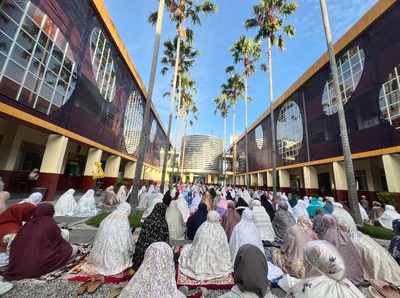
UMPO.AC.ID - Thousands of congregants packed the Al-Manar Mosque at the University of Muhammadiyah Ponorogo (UMPO) to perform the Eid al-Fitr prayer for 1447 H on Friday, March 20, 2026. Serving as the preacher (khatib), Ustadz Dr. Bambang Wahrudin, M.Pd., delivered a profound message regarding the meaning of returning to fitrah (pure nature) and the dangers of human greed.
In his sermon, Dr. Bambang emphasized that Eid al-Fitr is not a farewell to the acts of worship performed during the holy month of Ramadan, but rather a new beginning.
"Many people misunderstand, thinking that Eid al-Fitr is a separation from Allah. As if after Ramadan is over, we are free to return to sin. In reality, Eid al-Fitr is the starting line to begin a cleaner life, not the finish line to stop worshipping," he told the congregation.
Fighting the Greatest Enemy: Greed
Dr. Bambang highlighted that man's greatest enemy is not an external party, but the greedy desires dwelling within one's own chest. He cited a hadith of Prophet Muhammad SAW regarding the nature of humans who are never satisfied even if they possessed two valleys of gold.
"This greed is what triggers suffering in various parts of the world. We see how our brothers and sisters in Palestine, Lebanon, and Iran have become victims of the greed for power. Human blood has become cheap, while peace has become very expensive," he said.
He also reminded the audience not to let greed infect a Muslim's personality post-Ramadan, whether in small matters like food or in lifestyles prone to showing off (flexing) on social media.
Returning to Fitrah, Not Becoming a Fitnah
Furthermore, Dr. Bambang explained that returning to fitrah means returning to the purity and true identity of humans as ordained by Allah. He urged the congregation not to let mosques become empty again after being full for an entire month.
"If after Ramadan the mosques become empty again and we return to our bad habits, then we have not returned to fitrah (purity), but instead, we have become a fitnah (a source of trial or scandal)," he remarked.
At the end of his sermon, Dr. Bambang invited all congregants to use the momentum of Eid al-Fitr as a time to heal wounds and dissolve social castes. According to him, before Allah, all humans are equal; the rich bow in gratitude, and the poor stand tall in patience.
"Let us knock on the doors of hearts that were once locked by stinginess, reconnect ties of kinship broken by prejudice, and spread compassion just as Allah has bestowed His mercy upon us all," he concluded.
Berita Terkait
Populer
Wisuda ke 60 Pascasarjana Sarjana dan Diploma Univ...
- 23 February 2026

Tiba di Malaysia, Mahasiswa KKN Internasional UMPO...
- 21 January 2026

Perkuat Kiprah Global, UMPO Berangkatkan 22 Mahasi...
- 15 January 2026
Hadapi Modus Kekerasan Era Digital, UMPO Perkuat S...
- 12 February 2026
Kategori
Berita Terakhir
Akademisi UMPO Ungkap Pergeseran Pemicu Depresi, d...
- 06 April 2026
Akademisi UMPO Jadi Senior Reviewer di Forum Pendi...
- 02 April 2026
Panic Buying BBM Dipicu Hoaks, WR I UMPO Ingatkan ...
- 01 April 2026
Pembukaan RKTT UMPO, Fokus Evaluasi dan Capaian Be...
- 30 March 2026
Melebur Salah, Merajut Kasih: Kehangatan Open Hous...
- 25 March 2026
Media Online

Pengumuman Terakhir
Link Terkait
Hubungi Kami
Telp. (0352) 481124, 487662 (psw 2211) - Fax : (0352) 461796
humas@umpo.ac.id , akademik@umpo.ac.id
2026 © All Rights Reserved. Universitas Muhammadiyah Ponorogo English